
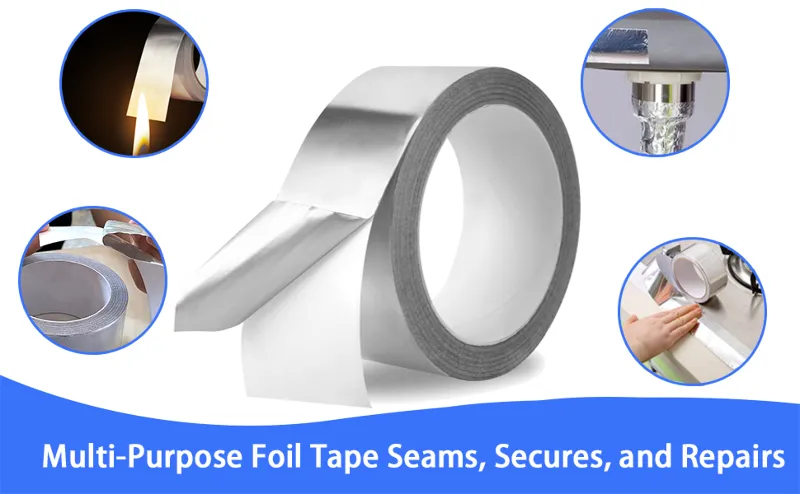
Aluminum foil tape is a widely used functional tape. It is made of flexible aluminum foil as the base material and coated with high-performance pressure-sensitive adhesive on one or both sides. Its core value lies in combining the excellent physical properties of metal aluminum and the reliable bonding performance of adhesives.
Core structure and materials of aluminum foil tape
Aluminum foil layer:
Material: Usually aluminum or specific alloys with higher purity, with a thickness of micrometer level (commonly 30µm - 100µm).
Features: Provide key barrier properties (blocking water vapor, gas, light, ultraviolet), electromagnetic shielding (EMI/RFI), high and low temperature resistance (usually -20°C to above 120°C), corrosion resistance, fire retardant (many products meet UL certification), and certain mechanical strength.
Surface treatment: Sometimes coating or anodizing is performed to enhance corrosion resistance or bonding with adhesives.
Adhesive layer:
Type: The most common are acrylic pressure-sensitive adhesives and rubber-based pressure-sensitive adhesives. Silicone adhesives may be used for special applications.
Features: Provides instant adhesion, good adhesion to various substrates, long-lasting bond strength, and a certain resistance to tearing and stretching.
Release paper/film:
Protects the adhesive layer from contamination and adhesion during transportation, storage, and before use.
How aluminum foil tape works
The working principle of aluminum foil tape is the synergy of its material properties and adhesive technology:
Physical barrier:
The aluminum foil layer itself forms a dense physical barrier, which effectively blocks water vapor, oxygen, odor, light (especially ultraviolet rays), and protects the object or sealed area.
Electromagnetic shielding:
Aluminum is a good conductor. The aluminum foil layer can reflect and absorb electromagnetic waves, providing electromagnetic interference (EMI) and radio frequency interference (RFI) shielding for electronic devices or cables.
Thermal management:
Heat reflection: The bright aluminum foil surface can effectively reflect thermal radiation (infrared rays), and is often used in pipe insulation outer covering, roof reflective film, etc., to reduce heat transfer.
Heat conduction: Aluminum itself has good thermal conductivity and can be used in applications that require heat dissipation or temperature uniformity (need to cooperate with heat dissipation design).
Temperature resistance: Aluminum foil and specific adhesives give the tape excellent high and low temperature resistance and adaptability to complex environments.
Bonding and sealing:
Pressure-sensitive adhesives provide fast and strong bonding to seal gaps, joints, holes, prevent leakage, and fix components. Its bonding strength increases with time and pressure.
Main application areas of aluminum foil tape
With its unique combination of properties, aluminum foil tape plays a key role in many industrial and civil fields:
HVAC system:
Insulation layer sealing: Sealing the joints and ends of air ducts and water pipe insulation materials (such as glass wool, rubber and plastic) to prevent energy loss (heat reflection/blocking) and moisture intrusion.
Duct repair and connection: Quickly repair metal duct leaks and assist in connecting duct components.
Construction and decoration:
Roof moisture barrier/vapor barrier: Used to paste lap joints to enhance sealing.
Floor heating reflective film splicing: Seal the reflective film joints to improve heat reflection efficiency.
Pipe wall hole sealing: Seal the gap between the pipe and the wall.
Automotive industry:
Wire harness shielding and protection: Wrap the wire harness to provide EMI shielding and mechanical protection.
Heat insulation and noise reduction: Paste it near the engine compartment and exhaust pipe to reflect heat and reduce noise.
Car body repair and sealing: Temporary or permanent repair and sealing.
Electronic appliances:
EMI/RFI shielding: Paste it on the seams of electronic equipment shells, cables or make shielding covers to suppress electromagnetic interference.
Grounding: Assist in establishing a grounding path.
Component fixing and heat dissipation: Fix electronic components or assist heat conduction in heat dissipation design.
Packaging industry:
Special item packaging: Used for packaging and sealing of special items that require light shielding, moisture-proof, anti-static, or electromagnetic shielding.
Other fields: Solar equipment installation and sealing, cold storage construction, ships, aerospace, etc.
How to choose the right aluminum foil tape?
When choosing aluminum foil tape, the following key parameters need to be considered according to specific application requirements:
Aluminum foil thickness:
Directly affects strength, puncture resistance, and cost. Thick aluminum foil is more durable but less flexible. Common range: 30µm - 100µm+.
Adhesive Type:
Acrylic adhesive: First choice! Weather, UV, high temperature (up to 120°C+), chemical resistance, transparent or light color, environmentally friendly. Suitable for long-term outdoor or harsh environments.
Rubber-based adhesive: High initial adhesion, good low-temperature performance, low cost. But it has poor weather resistance, high temperature resistance (usually <80°C), and solvent resistance, and may age, turn black, and leak oil. Suitable for short-term or cost-sensitive indoor applications.
Adhesion:
A measure of the force required to peel the tape (usually expressed in N/cm or N/in). It needs to be selected according to the surface of the adherend and the force.
Temperature range:
Aluminum foil tape must be able to maintain performance at the highest and lowest temperatures in the application environment.
Flame retardant grade:
For areas with high safety requirements, such as construction, HVAC, and electronics, be sure to choose flame-retardant aluminum foil tape that meets relevant standards (such as UL 723 / ASTM E84 Class A, Class B).
Conductivity:
The aluminum foil surface of standard aluminum foil tape is conductive. If conductive aluminum foil tape is required (i.e. the adhesive layer is also conductive), it must be specifically specified for grounding or EMI shielding where a continuous conductive path is required.
Width and length:
Select common specifications based on construction efficiency and needs.
As a multifunctional composite material, aluminum foil tape is far more valuable than ordinary tape. When purchasing, be sure to carefully evaluate key parameters such as aluminum foil thickness, adhesive type, temperature resistance, and flame retardancy based on specific application requirements (environment, temperature, functional requirements, safety standards).