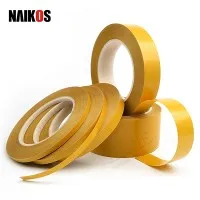

Naikos aluminum foil tape consists of an aluminum foil backing coated with acrylic adhesive or hot melt adhesive. It shows great conductivity performance and EMI shielding. With its unique properties, it has become an indispensable choice for tasks such as sealing, bonding, shielding, and protection.
Core characteristics of aluminum foil tape
Excellent sealing and barrier properties:
The aluminum foil layer can effectively block the penetration of water vapor, air, and odor, and is an ideal choice for pipeline sealing, seam repair, and a moisture-proof layer of insulation system.
Excellent temperature resistance and fire resistance:
Most aluminum foil tapes can maintain stable performance over a wide temperature range, and some special models can withstand 120°C or even higher temperatures. Its metal substrate itself is non-flammable, and some products have passed flame-retardant certification, which can delay the spread of flames.
Efficient electromagnetic interference (EMI)/radio frequency interference (RFI) shielding:
Conductive aluminum foil tape is a commonly used electromagnetic shielding material in electronic equipment, cable shielding, and chassis gap sealing, which can effectively block or weaken interference signals.
Excellent reflective and heat-insulating properties:
The bright aluminum foil surface can reflect most of the heat radiation, and is often used for HVAC pipe insulation layer outer wrapping, automobile engine compartment insulation, solar energy equipment, etc., to help improve system energy efficiency.
Good weather resistance and chemical stability:
High-quality adhesives make it resistant to UV rays, ozone, moisture, and a variety of chemical corrosion, suitable for indoor and outdoor use.
Convenient construction:
Tear and stick, no additional tools or curing process required, can be manually operated, and adapts to various irregular surfaces.
Main application scenarios of aluminum foil tape
Heating, ventilation, and air conditioning (HVAC) industry:
Duct joint sealing, insulation material outer sheath fixing, and lap sealing, pipeline insulation layer wrapping.
Construction and decoration field:
Roof and wall gap waterproof sealing, door and window opening sealing, insulation board joint treatment, and moisture-proof layer laying.
Electronic and electrical industry:
Electronic component shielding, cable bundle shielding wrapping, PCB board local shielding, chassis/cabinet gap conductive sealing.
Automobile manufacturing and maintenance:
Wire harness fixing and protection, heat shield fixing, muffler wrapping repair, and sheet metal joint temporary repair.
Industrial manufacturing and packaging:
Equipment insulation layer wrapping, pipeline marking, container sealing, and light-shielding packaging of special items.
Other fields:
Solar panel-related applications, ship sealing, cold storage construction, DIY maintenance, etc.
How to choose high-quality aluminum foil tape?
Aluminum foil thickness and purity:
Thickness affects strength, shielding effect, and barrier properties; purity affects conductivity and corrosion resistance. Choose according to application requirements.
Adhesive type:
Acrylic adhesive: Excellent comprehensive performance, good weather resistance, temperature resistance, solvent resistance, relatively high transparency, and good environmental protection. Suitable for most scenarios.
Rubber-based adhesive: High initial adhesion, good adhesion to low surface energy materials, good low-temperature performance, but temperature resistance, weather resistance, and solvent resistance are usually not as good as acrylic adhesive. The cost may be lower.
Adhesive viscosity index:
Pay attention to whether the initial adhesion, holding force, and peeling force meet the application requirements. Different substrates require different adhesion.
Temperature resistance level:
Clarify the highest and lowest temperatures of the application environment, and choose a model that can maintain stable performance within this range.
Special performance requirements:
Conductivity: When electromagnetic shielding is required, conductive aluminum foil tape must be selected.
Flame retardant grade: For places with fire protection requirements (such as buildings and vehicles), flame retardant products that meet the corresponding standards (such as UL94, GB/T) must be selected.
Chemical resistance: When exposed to specific solvents, greases, and other environments, the tolerance of the adhesive must be considered.
Color and appearance: Some applications have color requirements.
Width and length:
Choose the appropriate specifications based on construction efficiency and coverage area.
Brand and certification:
Choose a reputable manufacturer and pay attention to whether the product has relevant quality or safety certifications (such as ISO, RoHS, REACH, etc.